 Start - Smart Words
 Linking Words
Words which connect words, phrases, clauses or sentences are called conjunctions (see "to conjoin" = join, unite). The most common ones are 'and', 'or' and 'but'. These words all have different nuances and connotations but they all help to build up meaningful relationships within a sentence.
Conjunctions
Cohesive Devices
A variety of useful English Conjunctions exists, which complete this list of the most used Cohesive Devices. Together, they can help to express a cohesive view and easy understandable and readable texts.
There are three basic types of conjunctions:
Definition
- coordinating conjunctions
- used to connect two independent clauses
- subordinating conjunctions
- used to establish the relationship between the dependent clause and the rest of the sentence
- correlative conjunctions
- used to join various sentence elements which are grammatically equal
Coordinating Conjunctions
Comes usually in the middle of a sentence, and a comma is used before the conjunction (unless both clauses are very short). They join individual words, phrases, and independent clauses.
Whereas coordinating conjunctions join parts of a sentence, the purpose of transitional words and phrases usually is to join two 'sentences'.
Examples:
We can draw lessons from the past, but we cannot live in it. [Lyndon B. Johnson]
The purpose of most computer languages is to lengthen your resume by a word and a comma. [Larry Wall]
And, but, for, nor, or, so, and yet — are the seven coordinating conjunctions. To remember them, the acronym FANBOYS can be used.
F = for
A = and
N = nor
B = but
O = or
Y = yet
S = so
Subordinating Conjunctions
Also called subordinators, introduce a dependent clause. These adverbs that act like conjunctions are placed at the front of the clause - and a comma is needed at the end of the adverbial phrase when it precedes the main clause.
Examples:
If the only tool you have is a hammer, you tend to see every problem as a nail. [Abraham Maslow]
Some people make headlines while others make history. [Philip Elmer-DeWitt]
Conjunctions Concession
- though
- although
- even though
- while
Conjunctions Condition
- if
- only if
- unless
- until
- provided that
- assuming that
- even if
- in case (that)
- lest
Conjunctions Comparison
- than
- rather than
- whether
- as much as
- whereas
Conjunctions Time
- after
- as long as
- as soon as
- before
- by the time
- now that
- once
- since
- till
- until
- when
- whenever
- while
Conjunctions Reason
- because
- since
- so that
- in order (that)
- why
Relative Adjective
- that
- what
- whatever
- which
- whichever
Relative Pronoun
- who
- whoever
- whom
- whomever
- whose
Conjunctions Manner
- how
- as though
- as if
Conjunctions Place
- where
- wherever
Correlative Conjunctions
They are always used in pairs and denote equality; and show the relationship between ideas expressed in different parts of a sentence - and thus make the joining tighter and more emphatic. When joining singular and plural subjects, the subject closest to the verb determines whether the verb is singular or plural.
- as . . . as
- just as . . . so
- both . . . and
- hardly . . . when
- scarcely . . . when
- either . . . or
- neither . . . nor
- if . . . then
- not . . . but
- what with . . . and
- whether . . . or
- not only . . . but also
- no sooner . . . than
- rather . . . than
Conjunctive Adverbs
They are often used as a linking device between ideas. They show logical relationships expressed in clauses, sentences or paragraphs.
Conjunctive adverbs are very emphatic, so they should be used sparingly.
Similar to And
- also
- besides
- furthermore
- likewise
- moreover
Similar to But
- however
- nevertheless
- nonetheless
- still
- conversely
- instead
- otherwise
- rather
Similar to So
- accordingly
- consequently
- hence
- meanwhile
- then
- therefore
- thus
List of Conjunctions
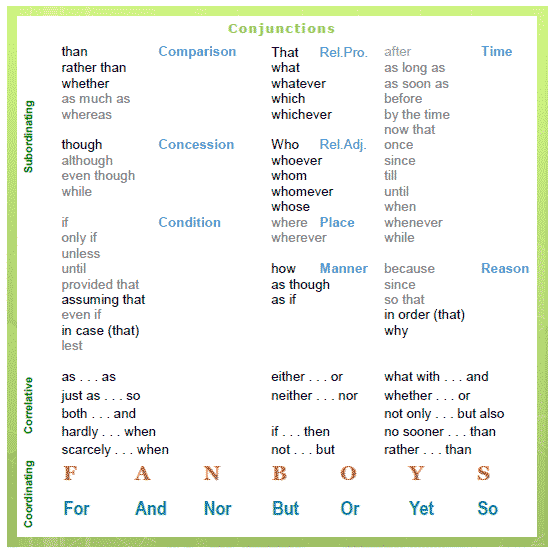
Conjunctions are also sometimes called - or put in the category of - Linking Words.
Please feel free to download them via this link to the category page:
Linking Words & Connecting Words as a PDF.
It contains all the conjunctions listed on this site. The image to the left gives you an impression how it looks like.
Further helpful readings about vocabulary (examples included): Smart Rephrased Proverbs ¦ Rare & Funny Tongue Twisters ¦ Learn Chinese in 5 minutes
Writing Tip: In order to save precious characters and typing time, there is a rich language of text abbreviations used in Text Messaging, Twitter, SMS and Chat.
It is quite a long list that probably does not include every Text Abbreviation & Internet Acronym ever invented — but the most popular.
Even if you restrain yourself from memorizing and using them all, you might find it handy to know a place where you can look up and thus decipher what someone is writing.
 Disclaimer
 Privacy Policy